

How much growth does transport investment actually cause?
Transport investment is often described as a route to economic growth. Better connections can help people reach jobs, firms reach customers, and places become more productive. But there is a surprisingly difficult question behind that idea:
The question is harder to answer than it first appears. Transport investment is not randomly spread across the country. Governments may invest in places that are already growing, because demand is rising and capacity is stretched — think of major capacity schemes in and around London. Or they may invest in places that are growing more slowly, where transport is part of a wider regeneration or rebalancing agenda. Both are legitimate policy choices, but they make the evidence harder to interpret.
Either way, simple comparisons can be misleading. If investment follows growth, we may overstate its effect. If investment is targeted at slower-growing places, we may understate it.
That was the challenge explored by CEPA for the Department for Transport. DfT needed a clearer evidence base for thinking about transport investment levels and priorities, including a UK-specific estimate of the relationship between transport investment and economic output. The work combined international evidence with new econometric analysis of UK regional data, but the most interesting part came from looking backwards.
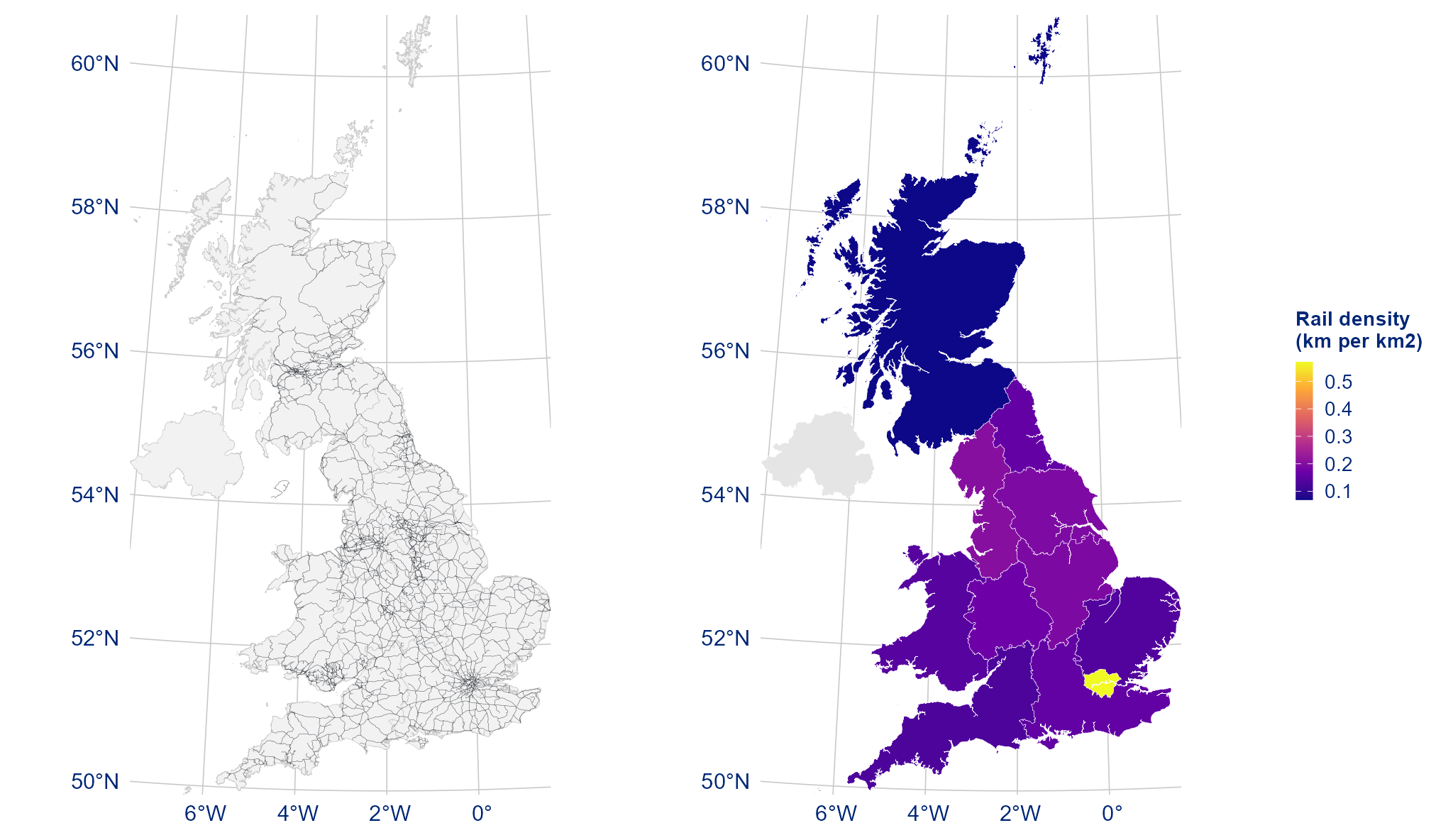
That inherited rail geography helped us understand where modern transport investment is likely to flow when national budgets change. Regions with denser legacy rail networks tend to have more assets to maintain, renew and upgrade. So when national transport spending rises, those places are more likely to see an increase in investment — not necessarily because their economies are growing faster today, but because they inherited more of the network in the first place.
This gives us a way to separate investment driven by current regional economic conditions from investment driven by historical infrastructure patterns.
In econometric terms, this was an instrumental variables strategy. In plain English, we asked:
When transport spending increases for reasons linked to inherited infrastructure, rather than current regional growth, what happens to economic output?
The choice of method made a difference. A simple correlation-based analysis found little or no relationship between transport investment and regional growth. But once we used the instrumental variables approach, the results suggested that a 10% increase in transport investment per person was associated with around a 0.7% increase in regional economic output per person.
From a simple question to usable policy evidence
That estimate should be used carefully. It is a benchmark and does not mean that all transport investment leads to economic growth or that future investments will have a similar relationship with economic growth. But it at least helps DfT get a better understanding of what that relationship has been in the past, on average.
It also shows how econometric analysis can be used to answer questions that are simple at face value, but difficult when you dig deeper. In this case, the shape of Britain’s inherited rail network helped us turn a difficult causality problem into evidence that’s useful for policy-making — and provided DfT with a clearer answer to one of today’s central infrastructure policy questions: what happens to economic output when we invest more in transport?