


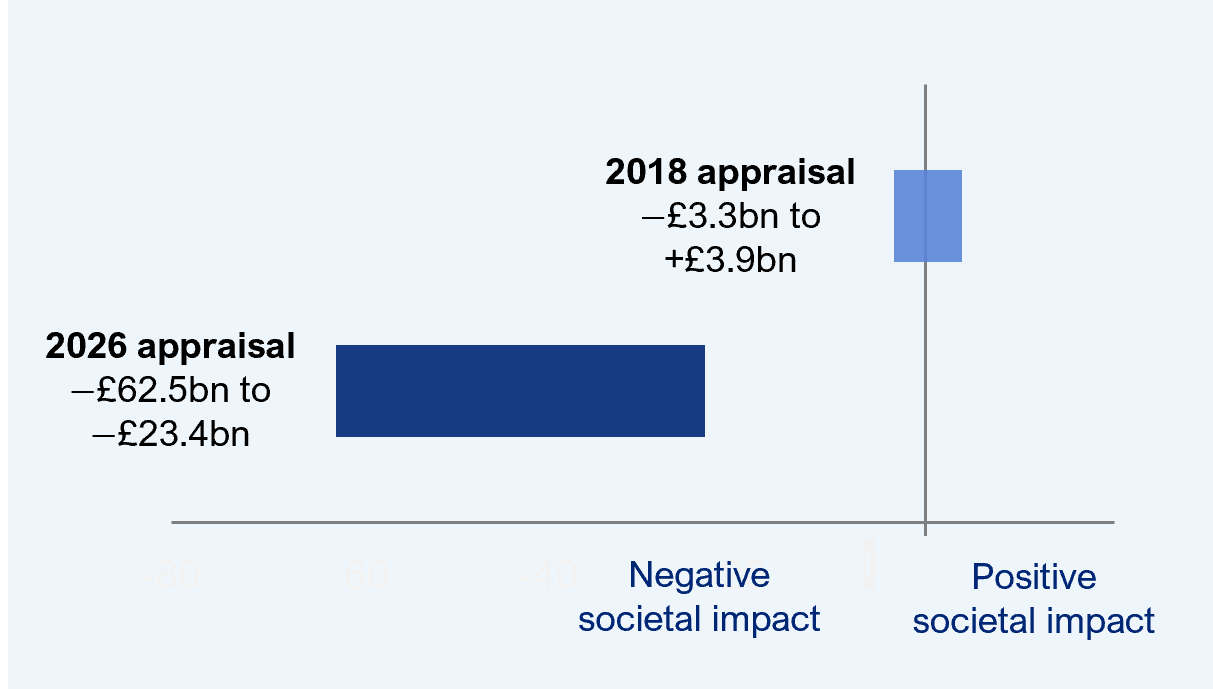
The Department for Transport’s (DfT) latest economic appraisal of Heathrow expansion1 is negative across every full scenario it reports. Its headline Net Present Value (NPV) estimates range from around -£63bn to -£23bn. That is, on the impacts DfT puts a monetary value on, the expected costs of expansion outweigh the expected benefits, implying a negative net impact on society.
So why might the Government still support Heathrow expansion despite the appraisal implying a negative impact on society?
The appraisal is not the whole economic case
The answer is that economic appraisal does not capture every effect relevant to the decision. Some impacts are excluded from the headline estimate because they are difficult to value robustly. For example, biodiversity and water-quality impacts are assessed separately rather than given a monetary value.
Expansion could also have wider economic benefits that are not fully captured in the economic appraisal. DfT models some of these separately and finds a positive impact on UK GDP. DfT cautions, however, that the estimated impact on UK GDP cannot be compared directly with the economic appraisal estimates – because they measure very different things and there is a potential overlap between them.2
Another consideration is that taxpayers are not expected to pay directly for the runway. Heathrow would raise the funding upfront and recover its costs over time through airport charges. This limits the Government’s direct financial exposure, although the economic costs are still borne elsewhere. There is a separate debate around whether those costs will ultimately be borne by passengers or by airlines.
The previous appraisal left open the possibility of a positive impact on society. The latest does not, making the wider economic case more important to the overall assessment.
So why is the latest appraisal more negative?
DfT’s 2018 appraisal3 found that the overall economic impact of expansion could be slightly positive or negative. The latest appraisal is clearly negative, as shown below.
Headline NPV ranges in DfT’s appraisals
Several changes in the way the costs and benefits are assessed help explain the difference.
| What changed since 2018? | Why it matters |
|---|---|
| Higher construction costs | Heathrow’s current expansion and modernisation plans total £49bn.4 This includes £21bn for the third runway, up from £14bn previously, largely due to construction inflation. |
| Aviation carbon | The latest appraisal better accounts for emissions from additional flights. Environmental costs rise from around £1.9bn to £34bn–£35bn. |
| Appraisal scope | The headline appraisal now focuses on UK impacts rather than all passengers, reducing the benefits counted. |
| Cost pass-through | DfT now tests the effect of higher airport charges on fares and demand. Under its main scenario for demand, economic growth and technology, passing these costs on to passengers makes the appraisal around £11bn more negative. |
| Demand forecasts and phasing | More capacity at other London airports reduces additional demand at Heathrow, while phased delivery delays some benefits. |
What questions remain?
These changes help explain why the appraisal is now clearly negative. But they also leave important questions about how expansion would work in practice and how the wider economic case should be assessed.
- How affordable would expansion be? How would higher airport charges affect fares, demand and airline investment? The appraisal partly considers this through a simplified pass-through assumption, but further work is needed.
- How robust are the wider economic benefits? What drives DfT’s GDP estimate, and what role do trade, connectivity and investment play?