


Water bills are rising, making affordability support increasingly important. Around 2 million households in England and Wales already receive lower bills through company social tariffs, but who gets help, and how much, still depends on where they live. A national approach could make support more consistent, but only if the eligibility rules are clear, practical and easy to explain.
Social tariffs are discounts on water bills for customers who are struggling to pay. In 2024-25, water companies across England and Wales helped around 1.96 million customers through social tariff schemes, with an average bill reduction of £190.1
Because water companies each run their own schemes, eligibility and support still vary by area. The Consumer Council for Water (CCW) has described this as a postcode lottery.2
This variation is central to the case for a national approach. CCW has recommended a single social tariff so support is based on need, not location.3 The Independent Water Commission, chaired by Sir Jon Cunliffe, has also recommended a national social tariff to provide consistent help for low-income customers who need support with their bills.4
However, the detailed design of a national approach remains open. The Government's 2026 water white paper points to better guidance, more consistency across schemes, and greater awareness and uptake.5 But key design questions remain: who should receive support, how much support they should get, and who should pay?
Those questions are more complex than they first appear. They often rely on technical concepts that are unfamiliar outside policy circles. This blog explains some of those concepts in plain English, focusing on eligibility: who should qualify for help, and why terms such as “bill-to-income ratio” and “equivalised income” matter.
A good eligibility test looks at both bills and income
There are several ways to decide whether a household should qualify for a water social tariff.
- One option is an income threshold. This asks whether a household’s income is below a set level. It is simple to explain, but it can miss people with high unavoidable costs.
- A second option is benefits-based eligibility. This asks whether someone receives certain benefits, such as Universal Credit or Pension Credit. This can make schemes easier to automate through data matching. But it may miss households that are struggling but not claiming benefits, including some working households and people with fluctuating incomes.
- A third option is a bill-to-income ratio. This asks whether a household’s water bill is high compared with its income. For example, a household might qualify if its water and sewerage bill is more than 5% of its income.
This third option is attractive because it looks directly at affordability. A household can struggle because its income is low, because its bill is high, or because both are true.
A bill-to-income ratio is trying to answer a simple question: how much of a household’s income is being taken up by the water bill?
This is important because water bills are not the same for everyone. Some households may have high bills because they live in a high-cost area. Others may have high essential water use because of a medical condition, disability or a larger household.
But it also uncovers new questions. What income should be used, and should benefits be included? Should housing costs and household size be taken into account? How should fluctuating income be treated?
This is where economic language can get in the way of public understanding.
“Equivalised income” is just income adjusted for household need
One of the most important terms is equivalised income.
Two households can have the same income but very different living standards. £30,000 supports a single adult very differently from a family of five.
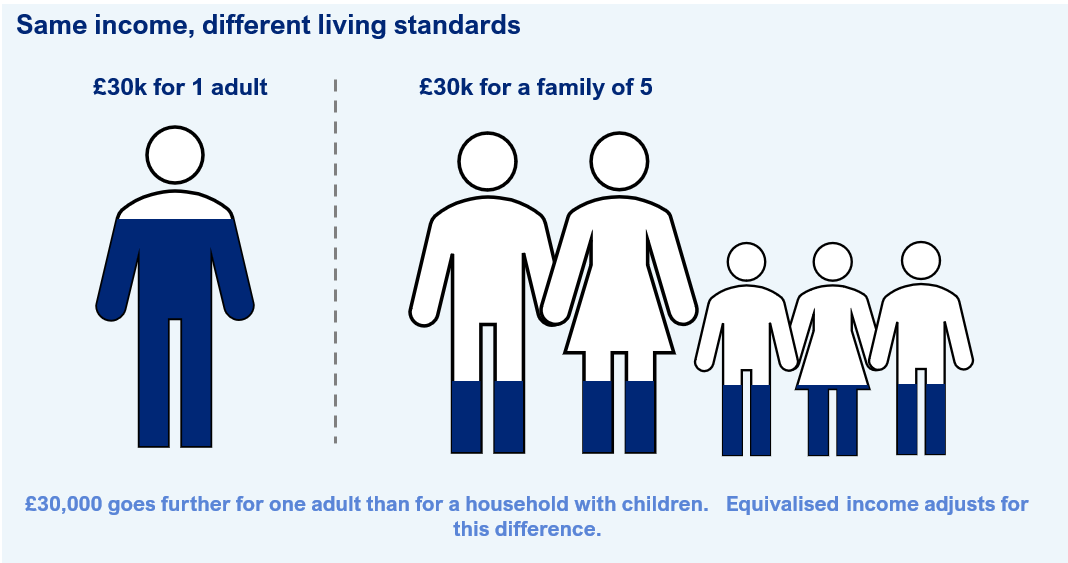
Equivalised income adjusts household income to reflect household size and composition. It recognises that larger households need more income to reach a similar living standard, while some costs are shared.
Put simply, equivalisation tries to compare households more fairly, which makes it useful for measuring eligibility for a social tariff. But it also needs to be explained carefully. Equivalised income is not the same as income per person. It is an adjusted income measure that reflects household need.
Why good communication is part of good social tariff design
A tariff can be well designed in theory and still fail in practice. Customers need to understand whether they might qualify. Policymakers need to be able to explain the rules. Companies need to apply them consistently.
“Equivalised income” is a good example. It helps compare living standards across different households, but the term itself is not customer friendly. People should not need to understand an equivalence scale to know whether they might get help with their bill.
Simple tools are one way to support customer understanding, translating technical rules into questions they can easily answer.
We have included an example equivalisation calculator below to support wider understanding and help policymakers, companies and the public engage with social tariffs.
Equivalised income calculator
Use this calculator to adjust household take-home income for household size and composition.
Enter your household details
How the calculation works
The calculator uses the modified OECD equivalence scale: 1.0 for the first person aged 14 or over, 0.5 for each additional person aged 14 or over, and 0.3 for each child aged under 14.
It divides annual household take-home income by the household equivalence factor. The result is an illustrative equivalised income.
Sources (accessed 17 September 2026): ONS guidance on equivalised income and Eurostat glossary on equivalised disposable income .
This calculator is illustrative only and is not an eligibility assessment for any social tariff.
A national social tariff is intended to make support fairer and more consistent. In practice, achieving that depends on whether customers can understand and access the support available to them.
CEPA has advised on measuring water poverty and the design and targeting of affordability support, including social tariffs.