


In 2027, Ofgem will set the ED3 network price control. This will determine revenue allowances for Distribution Network Operators (DNOs) across Great Britain for 2028-2033; a period in which they are expected to undertake a significant investment programme to support Britain’s energy transition.
Under the ED3 framework, DNOs will receive an allowance intended to cover efficient costs and to give network owners a fair return on the capital they have invested, with consumers protected against costs above that level. On top of this, DNOs are subject to performance incentives. These measure outputs delivered by DNOs and reward or penalise them depending on whether they meet certain targets. For example, how long it takes a DNO to connect new users to the network, or how many customers experience an outage and for how long.
The underlying idea is simple. Because DNOs are regional monopolies, it is not enough to regulate only the costs they are allowed to pass on to consumers’ bills. They should also be incentivised to provide a high-quality service.
When Ofgem assesses the costs submitted by DNOs in their business plans, it largely does so comparatively. It looks at companies’ cost submissions and historical costs, adjusts for external factors outside DNOs’ control, and uses this comparison to set efficient cost allowances. When it comes to performance incentives, however, DNOs generally earn rewards by beating an absolute target, rather than by outperforming each other.
In its response to Ofgem’s ED3 Sector Specific Methodology Consultation, Citizens Advice wrote:
“We strongly recommend that most incentives have relative targets, rewarding the best performing DNOs and penalising the worst, with a fixed minimum standard set as a backstop.”
- Citizens Advice, response to Ofgem’s ED3 SSMC, December 20253
Building on this, Citizens Advice commissioned CEPA to explore how introducing more relative performance measures into the ED3 incentive package could lead to better outcomes for consumers. This blog post explores the issues affecting how regulators can effectively incentivise network companies to compete on consumer outcomes.
Competition can drive improvements in quality
In our report, we present a simple example of quality-based competition.
Imagine a town with several cafés and a fixed number of customers. One café finds a way to serve noticeably better coffee, perhaps by hiring a particularly skilled barista or switching to a better coffee variety. Customers move across, the café earns higher returns for a period, and its competitors have an incentive to catch up.
Over time, the other cafés find ways to improve as well, and their customer numbers improve again. A new equilibrium is reached in which the cafés once again earn normal returns, but customers across the town can all enjoy better coffee. If a café is unable to catch up with industry-wide improvements in quality, it will continue to lose customers and eventually exit the market. However, new cafés could enter the market and offer coffee of higher-than-average quality, continuing to exert competitive pressure on all other cafés and delivering continuous quality improvements for consumers.
Electricity networks do not compete for customers in this way, because each DNO is a monopoly that serves a particular region. But a regulator can recreate part of the same pressure through relative performance incentives: companies providing better outcomes for consumers earn rewards, while those below the benchmark have an incentive to catch up.
This can be particularly useful where it is difficult for Ofgem to confidently set a robust absolute performance target in advance. Rather than Ofgem having to decide today what good performance should look like several years from now, the benchmark can move as companies improve. In principle, this creates continuing pressure to improve quality for consumers.
Competitive pressure can help when three conditions are met
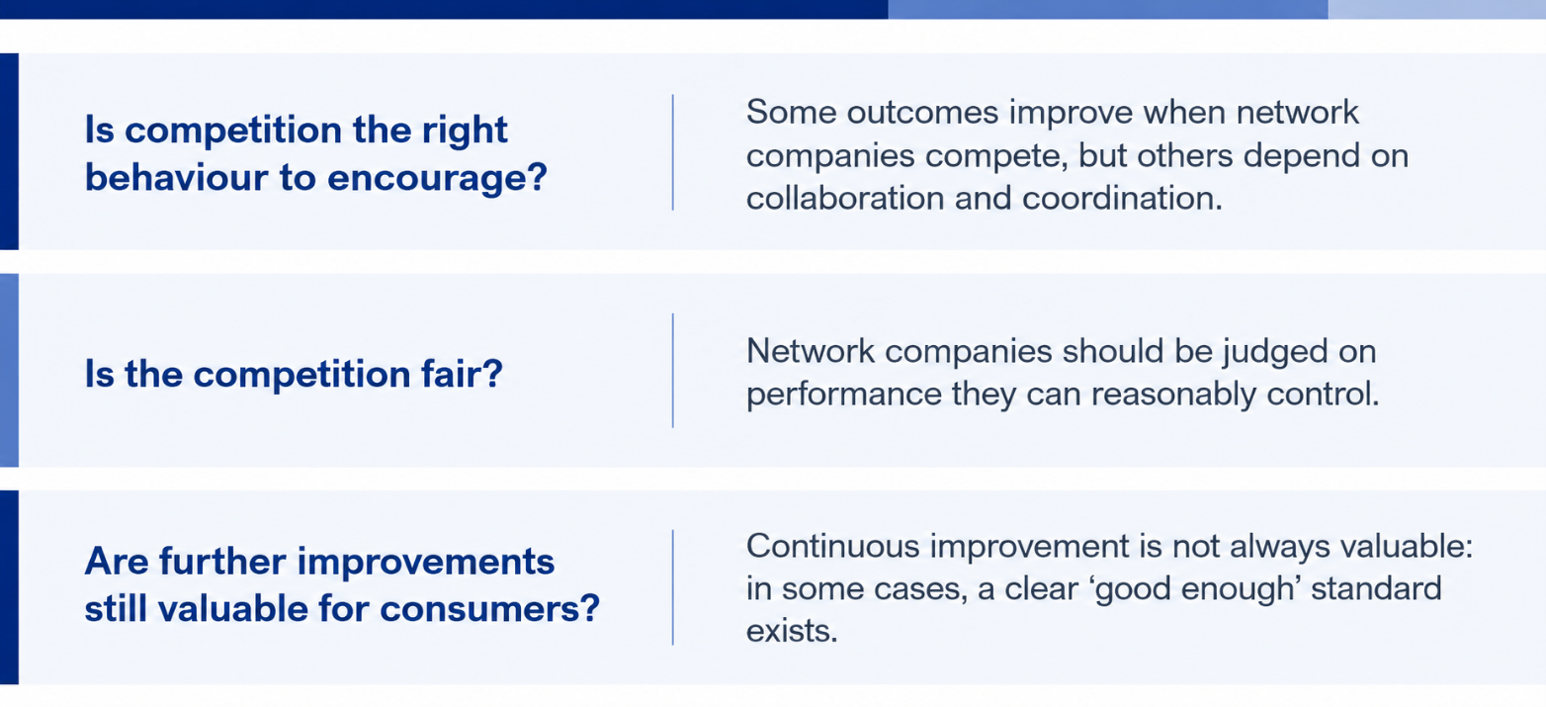
We identified three questions to help identify where relative performance incentives are likely to be most effective:
1. Is competition the right behaviour to encourage?
Some outcomes are naturally competitive: if one network connects customers more quickly, manages its system more efficiently or provides a better service, it is reasonable to expect others to learn from it and improve.
But competition is not always the right answer. Some outcomes might depend on network companies working together, sharing information or coordinating with local authorities and other organisations. This might include support for consumers in vulnerable situations and collaborative streetworks. A relative incentive may not be appropriate if it encourages companies to protect their own ranking rather than collaborate with others.
2. Is the competition fair?
For a relative incentive to work, each network company needs to be able to influence the outcome being measured. DNO regions spanning from the North of Scotland to the South of England can differ greatly from each other in ways that inevitably affects their performance. A company should not receive a penalty simply because it started from an inherently more difficult position.
A lot depends on how performance is measured. A direct comparison may be fair for some outputs, but for others, it may be better to compare each company’s improvement against its own historical performance, or to adjust the metric for important external factors. Relative incentives can also help where an unexpected event affects the whole sector, because the industry benchmark will move with it.
The issue of structural factors outside of network companies’ control affecting performance is not unique to relative incentives. Any financial incentive should reward or penalise companies for outcomes they can meaningfully influence. But it may be particularly important when one company’s position directly affects another’s reward or penalty.
3. Are further improvements still valuable for consumers?
Relative incentives are most useful where continuous improvement is valuable. A potential example of this are incentives aimed at reducing connection times, since reducing delays can support customers and help low-carbon technologies connect to the network. Evolving activities such as distribution system operation may also benefit from a dynamic benchmark, because it is difficult to know in advance what best practice will look like by the end of ED3.
Other outcomes have a clearer point at which further improvements bring little additional benefit to consumers. If service is already consistently excellent, encouraging companies to improve further may not make much practical difference. In those cases, an absolute target may make more sense than a permanent race to improve.
There are also cases where the priority is simply to ensure companies meet a minimum standard. For example, no network company should be rewarded for unjustified under-delivery of work needed to maintain the safety and health of its assets, however its peers perform. Here, the best design may be a hybrid: network companies compete against each other, but rewards are available only if they also beat a backstop level of performance set by Ofgem.
Price controls need to remain a ‘fair bet’
Relative incentives also need to be considered as part of the whole price control package. The Independent Water Commission’s Cunliffe Review raised concerns about a possible ‘doom loop’ in the water sector: companies that begin from a weaker position can face repeated penalties, leaving them less able to invest and catch up, which can then contribute to further underperformance.
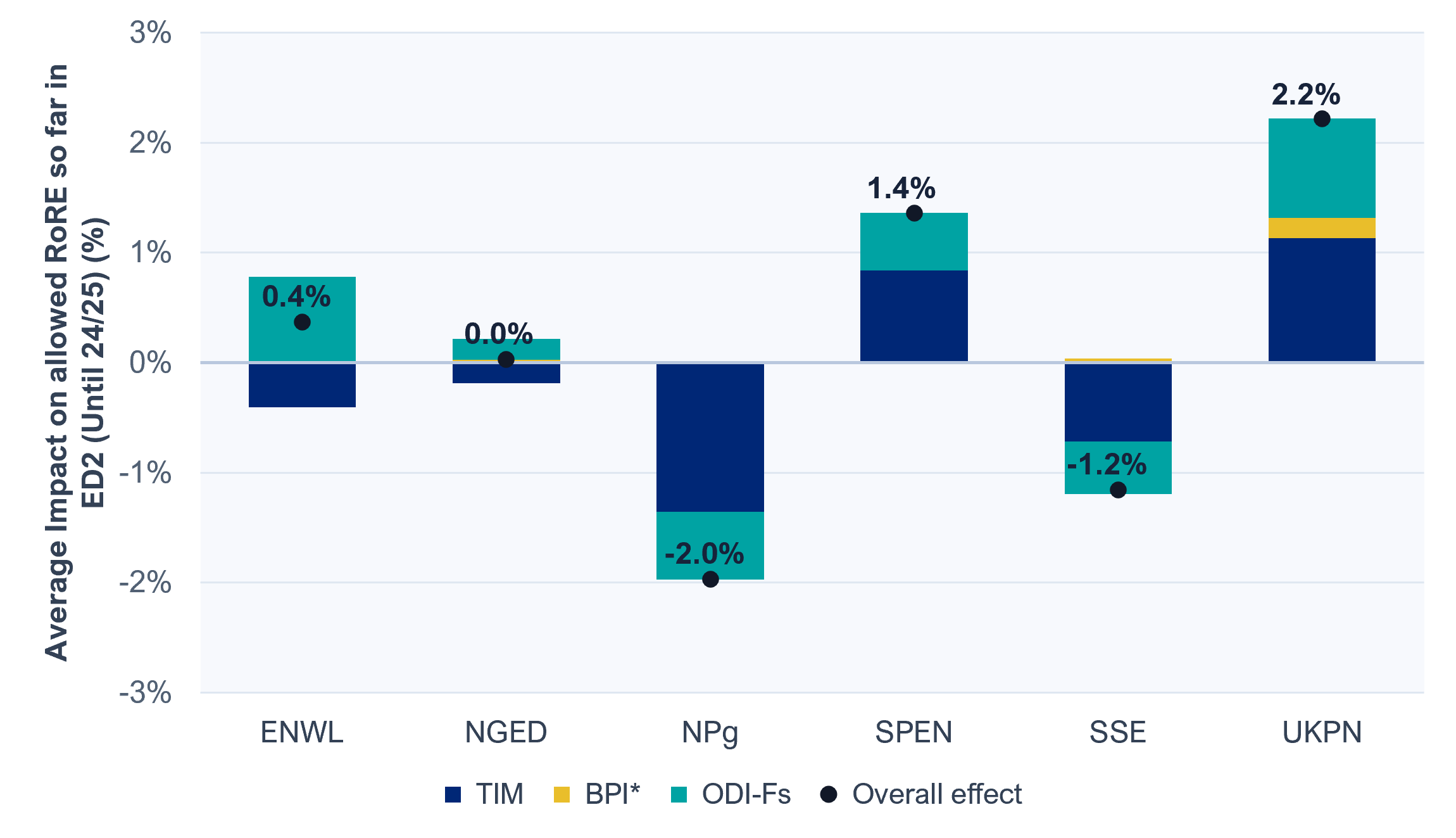
However, the available evidence for the current ED2 price control does not show a consistent bias towards penalties in the electricity distribution sector. Across the first two years for which data are available, the average effect of the main incentives was a small net reward. The picture differs materially by DNO group, with some receiving net rewards and others net penalties.
However, the risks identified in the Cunliffe Review still need to be taken seriously. Relative incentives may increase perceived risk because companies do not know the benchmark in advance and, depending on the detailed design, some companies may receive penalties even if they perform well against the old absolute standard or improve significantly over time. On the other hand, a relative benchmark can reduce the risk of Ofgem setting an absolute target that turns out to be too easy or too difficult for the sector as a whole.
The key question is therefore not whether every individual incentive should be based on relative performance. It is whether the overall price control package remains a fair bet: an efficiently run company should have a reasonable opportunity to earn a return reflecting the risks it faces and the outcomes it delivers, while consumers are protected from excessive costs and returns.
Deciding what that balance should look like in ED3 will be one of Ofgem’s most difficult tasks. Relative performance incentives can be a useful part of the answer, particularly where they create genuine and fair pressure to improve. But competition is a tool, not an objective in itself. It is most effective when it forms part of a regulatory framework in which incentives, performance measures and the wider regulatory package are designed to work together.
You can read the full report here.